Civic Portals

Great Arrivals, Lasting Architecture

Airports banish travelers to distant concrete peripheries, but the 19th-century railway terminus delivers passengers directly into the pulsing historic center of the city. These colossal stations were the first public secular cathedrals—celebrations of civic pride, iron engineering, and the romance of departure.

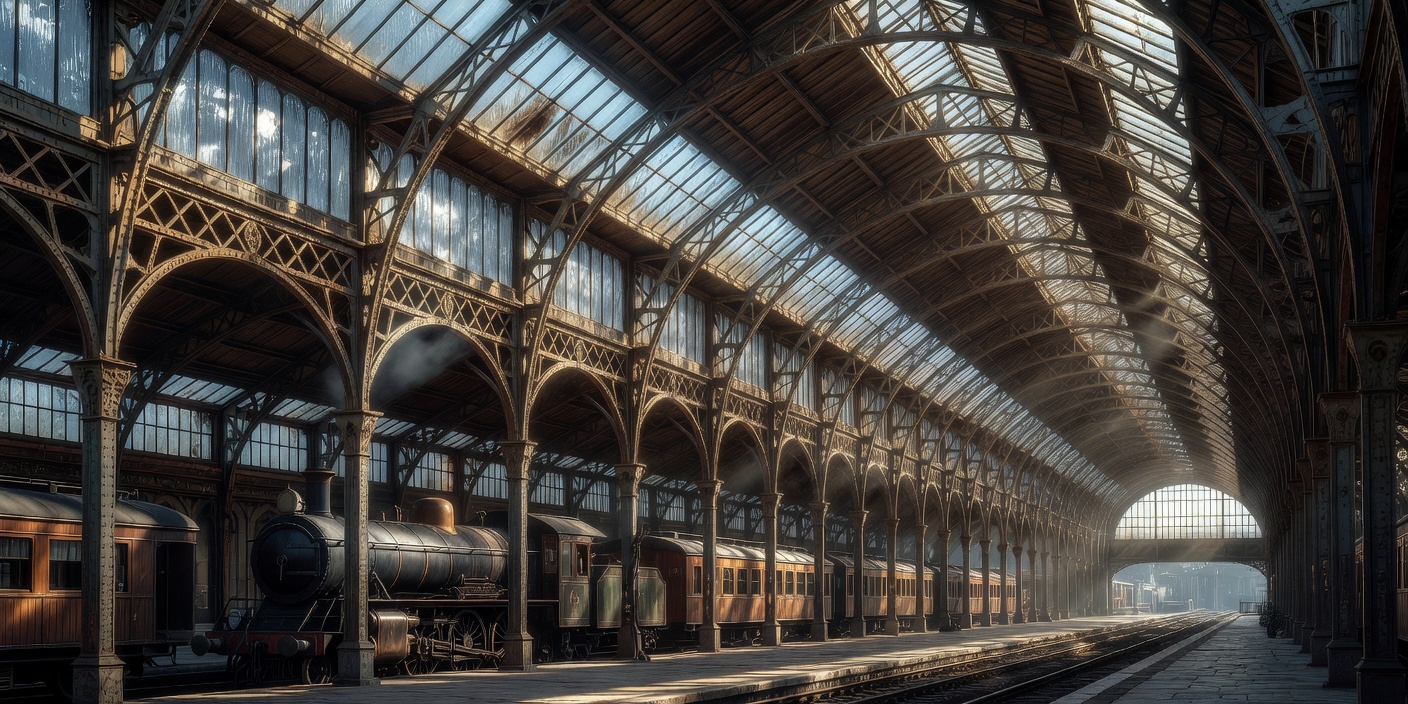
Illustration of a vaulted 19th-century wrought iron train shed bathed in morning light slanting through glass panes
Figure 3.0 — The great iron and glass train sheds created unprecedented column-free spaces to celebrate arrival.

Historical Context

The Duality of Iron Shed and Stone Palace

The classic railway terminus of the golden age solved a unique architectural problem: it required a functional industrial hangar capable of sheltering multiple tracks from soot and steam, paired with an elegant urban facade that matched the civic scale of city squares. This gave rise to the dual-faced terminal: an engineering wonder of curved iron trusses behind, and a monumental palace of limestone, brick, and statues in front.

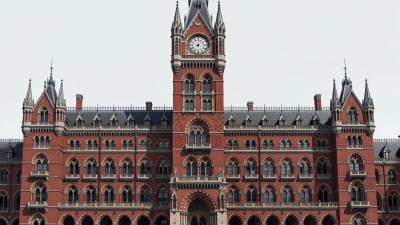
Illustration of St Pancras International station facade in London London, UK

Completed 1868

St. Pancras International

William Henry Barlow's 240-foot single-span roof was the largest enclosed space in the world at its opening. In front, George Gilbert Scott designed the Midland Grand Hotel in red Gripper's brick with soaring Gothic pinnacles. Rescued from demolition in the 1960s by Sir John Betjeman, it stands today as the restored gateway for continental trains.
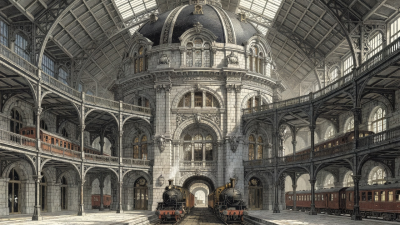
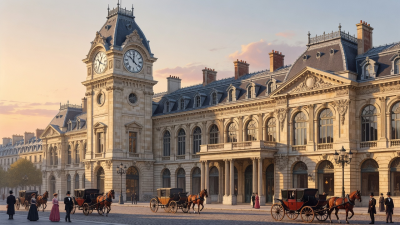
Illustration of Antwerpen-Centraal station rotunda in Belgium Antwerp, Belgium

Completed 1905

Antwerpen-Centraal

Architect Louis Delacenserie fused twenty different styles of marble and stone to crown the central hall with a 75-meter dome, drawing inspiration from the Pantheon in Rome. Clément Van Bogaert's immense iron and glass vault rises behind, sheltering four levels of contemporary electrified tracks.

Illustration of Gare de Lyon in Paris with its ornate clock tower Paris, France

Built for 1900 Expo

Gare de Lyon

Featuring a 67-meter clock tower visible across the 12th arrondissement, Gare de Lyon has long represented the sunlit corridor to the Côte d’Azur. Inside, the opulent Belle Époque restaurant Le Train Bleu boasts 41 hand-painted murals depicting destination landscapes along the PLM line.

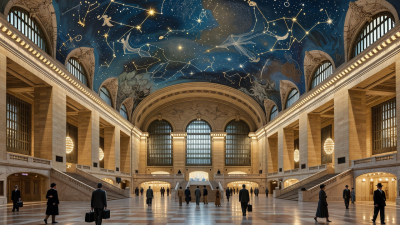
Illustration of Grand Central Terminal concourse with the celestial ceiling mural New York, USA

Completed 1913

Grand Central Terminal

Reed and Stem joined by Warren and Wetmore designed this Beaux-Arts masterpiece. The iconic Main Concourse features Tennessee marble floors, a brass clock valued in millions, and an astronomical ceiling mural depicting the Mediterranean winter sky with 2,500 gold-leaf stars.

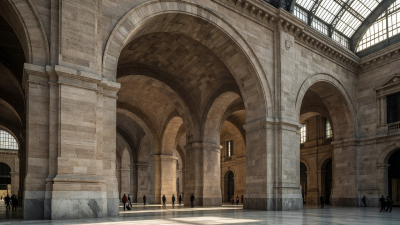
Illustration of the immense stone arches of Milano Centrale in Italy Milan, Italy

Completed 1931

Milano Centrale

Ulisse Stacchini's monumental terminus was conceived to embody state majesty, combining Roman classical grandeur with Art Deco flourishes. Vast winged stone horses flank the roof, while twenty-four platform tracks branch beneath five overlapping iron vaults stretching over 340 meters.

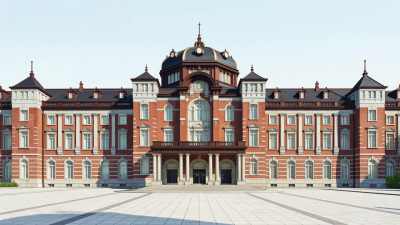
Illustration of the Marunouchi red brick facade of Tokyo Station Tokyo, Japan

Completed 1914

Tokyo Station (Marunouchi)

Designed by master architect Kingo Tatsuno in the Dutch neo-Renaissance style, this imposing red-brick facade stands opposite the Imperial Palace grounds. Faithfully restored following war damage, its twin octagonal domes feature reliefs of zodiac animals and eagle motifs.

The Station Walk

The Value of Arriving Early

Experienced rail travelers never rush onto the train at the final bell. Arriving an hour before boarding allows one to walk the concourse, admire the departure board, observe the locomotive decoupling, and sample station espresso in an environment rich with civic life.

In contrast to the sterile anxiety of airport security corridors, a historic station grounds the traveler in the real fabric of the city before the first kilometer is logged.

Explore the Connecting Journeys