Route Compendium

Routes with a Sense of Occasion

Not every railway is constructed for scenic spectacle; many exist purely to move tons of freight or rush commuters between business parks. Here, we isolate lines where geography, civil engineering, and landscape collide to produce an experience worth traveling for in its own right.

Curator's Note

The Benchmark of Great Rail Lines

A route earns our attention when it satisfies three non-negotiables: a sustained progression of landscape types, carriages engineered to frame rather than obstruct the view, and a relaxed operating speed that treats landscape as narrative rather than blur.

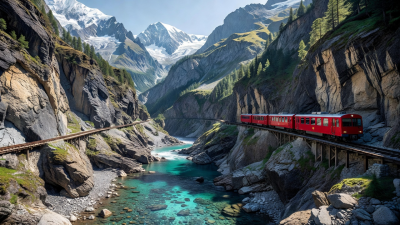
Illustration of a red panoramic carriage moving along a crystalline alpine river in a steep gorge Switzerland

Zermatt to St. Moritz

The Glacier Express

Spanning 291 bridges and 91 tunnels over eight unhurried hours, this narrow-gauge legend links the Matterhorn to the Engadin valley. The crossing of the Oberalp Pass at 2,033 meters and the traverse of the Ruinaulta (Swiss Grand Canyon) represent masterclasses in early 20th-century mountain surveying.

Ideal Window: Late autumn for snow-dusted summits alongside amber larch valleys, or deep February for sheer winter fairytale immersion.
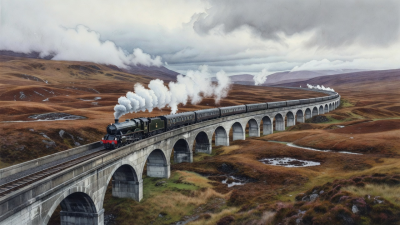
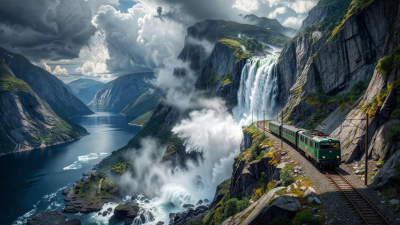
Illustration of a steam locomotive and carriages crossing a curved concrete viaduct over Scottish moorland Scotland

Glasgow to Mallaig

The West Highland Line

Consistently ranked among the most evocative wild routes in Northern Europe, the track climbs from Helensburgh up past Loch Lomond before traversing the desolate peat bogs of Rannoch Moor—where tracks float on heather-bale foundations—before reaching the 21 arches of Glenfinnan Viaduct.

Ideal Window: May to June when gorse blooms vibrant yellow and the northern twilight stretches late past 10 PM.

Illustration of a green electric locomotive winding beside a thunderous cascading waterfall in a deep fjord valley Norway

Myrdal to Flåm

The Flåmsbana

Dropping 863 meters down to Aurlandsfjord over just 20 kilometers, this standard-gauge adhesion railway has an average gradient of 1 in 18. Passengers watch roaring glacial rivers carve through nearly vertical canyon walls while the train negotiates five separate braking systems.

Ideal Window: Spring meltwater season in late May, when the Kjosfossen waterfall is at its most deafening power.

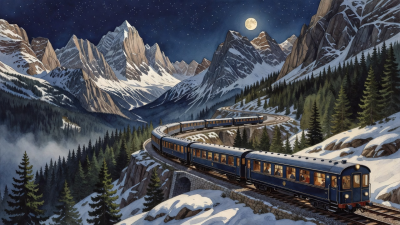
Illustration of vintage midnight blue passenger carriages winding through Austrian Alpine passes Trans-European

Paris to Venice

The Arlberg Continental Corridor

Riding historic rolling stock from Gare de l'Est via Switzerland and the Austrian Alps toward Santa Lucia station brings travelers face-to-face with the golden age of international night trains. The shift from Parisian suburbs to Alpine peaks and finally the Venetian lagoon is unmatched in dramatic contrast.

Ideal Window: October, avoiding summer humidity and tourist crowds across Venice while catching crisp alpine vistas.

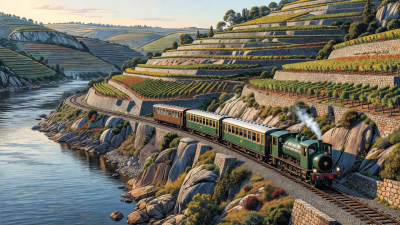
Illustration of a heritage train hugging the banks of the Douro River lined with stepped vineyard terraces Portugal

Porto to Pocinho

Linha do Douro

Tracing the granite cliffs of Northern Portugal, the Douro line clings directly to the riverbank for over 160 kilometers. Passengers look out over ancient terraced quintas where port wine grapes have been harvested since Roman antiquity, accompanied by station houses covered in hand-painted azulejo tiles.

Ideal Window: September vintage grape harvest, when terrace hillsides glow with rich autumnal copper and gold.

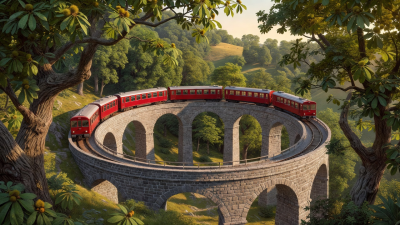
Illustration of a red train on the Brusio circular stone viaduct surrounded by chestnut trees Switzerland & Italy

Chur to Tirano

The Bernina Pass & Spiral

A UNESCO World Heritage railway that crests at Ospizio Bernina (2,253 m) without cogs or racks before plunging down through the famous open-air Brusio circular viaduct. It bridges the cultural and climatic gap between alpine glaciers and Italian palm trees in under four hours.

Ideal Window: Year-round; dramatic contrasts between snowy peaks and sunny valley floors are sharpest in early April.

Analysis

Comparing Modern High-Speed vs. Scenic Heritage Lines

A frequent dilemma for travelers is whether to book high-speed services (TGV, Frecciarossa, ICE) or regional scenic trains along the same corridor. High-speed lines are optimized for velocity, utilizing long concrete viaducts, tunnels, and acoustic walls that deliberately isolate passengers from the territory. Scenic heritage lines, by contrast, hug valley floors and cliff contours at an average speed of 35 to 60 km/h, turning every turn into an observation moment.

Plan Your Route Logistics